How Flyletter Is Engineered to Write in Your Voice
AI stops sounding like you after the first paragraph because of structural overload, not model failure. See the three-layer architecture that fixes it.

8 min read

You paste your best writing samples into an AI chatbot. You ask it to write in your voice. The first paragraph lands close enough that you lean in.
Then the second shows up, and it reads like a stranger wrote it.
The rhythm flattens. The word choices go corporate. By the end of the paragraph the thing sounds like every other draft ever written by AI, and you assume the model just can't do voice.
But you're wrong. AI can write in your voice, if you do it right.
It's likely that you're just giving your AI a little background on who you are, and then having it read a bunch of old writing samples and execute on a set of writing instructions. Maybe you have a list of anti-AI phrases you forbid.
You're basically cramming who you sound like, what you're writing, and how good it needs to write into a set of directives that confuses the AI. Compliance collapses under the load, and it breaks most of the prompt engineering best practices I learned building Flyletter's agents.
So the stranger writing your second paragraph isn't a model failure. It's a structural failure.
The fix is to engineer a three-tier prompt architecture that sets a quality floor, captures your brand voice, and then instructs the agent on how to read it and what to do with it.
That's how I built Flyletter, and I'm opening up the kimono to show you exactly how it's constructed to capture your actual brand voice so it always sounds like you.
The Three-tier Brand Voice System
Flyletter is built on a three-layer prompt architecture that every agent follows:
- The quality floor: All agents start with universal writing standards. This is the base layer, and it's included on every single output before the system even knows whose voice it's writing. This is where you strip out all the AI tells, so even if it doesn't know your voice, it won't sound like AI.
- Your brand voice profile: On top of the quality floor sits your brand voice profile that catalogs how you write and who you're writing for, built from just three writing samples. This is what tells the Flyletter agents exactly how you sound.
- The engine that reads it: The third layer are the agent instructions that tell each agent how to read your brand profile and how to apply it to their specific task. For example, the draft agent gets full instructions on how to sound like you, while the social media agents get the parts of the profile that help them write banger hooks in your voice.
That's the whole architecture. The rest of this article is me opening up each layer to show you how it's built. Feel free to try and do this yourself, and I encourage you to try Flyletter and compare the output against your own.
1. The Quality Floor
The quality floor is the base layer, and it fires on everything regardless of who you are. This layer doesn't need to know who you are yet. It just needs to know what generic AI sounds like so it can strip it out.
That's the whole point of putting it first. You catch the tells that would ruin any writer's draft before you spend any effort on the parts specific to one writer. These universal writing standards are split into two halves. One says what good writing does. The other names the AI tells and kills them (harsh).
What Good Writing Does
The first half is the positive floor. It's the standard every output should clear before it tries to assume your voice:
- Sentence craft: Vary length on purpose. Short punches, medium carries, and long builds.
- Concision: Every word earns its place. One strong word beats a weak word plus a modifier.
- Paragraph discipline and rhythm: One idea per paragraph. A standalone one-sentence paragraph is powerful when a thought earns its own space.
- Formatting discipline: Every bold, header, and structural element serves the content.
- The anti-fabrication standard: A personal anecdote is a fact. A fabricated story destroys your credibility the instant a reader recognizes it.
- The Human Test: Before anything ships, ask, "would a busy, smart human write this way?"
That's the ground truth. The standard that all Flyletter output must adhere to.
The AI Tells and How to Kill them
Even though the AI knows the mechanics of good writing, it still needs to know what bad writing sounds like and how to avoid the dead giveaways:
- The three top giveaways: Stage direction ("here's the thing"), em dashes (sad, because I love em dashes), and the colon for dramatic pause.
- The pattern families underneath: Contrast reveals ("This isn't X. It's Y."), sweeping scene-setters ("In today's landscape"), dramatic imperatives ("Picture this:"), and more.
- The forbidden phrases: The named words that flag AI on sight. Things like "unlock" and "unleash."
That's the floor, both halves. It catches what would sink any draft before the system spends a single token on your actual voice.
2. Your Voice Profile
Most tools bolt a brand-voice text box onto a chatbot, store a sentence like "friendly but professional," and call the job done. That's a label, and a label can't hold a voice.
What replaces it is Flyletter's brand voice profile built from three writing samples across six key categories:
- Audience and positioning, including your unique differentiator
- Your content philosophy and your intended reader takeaways
- The writing mechanics of how your writing is actually formatted
- Signature elements that make your writing your own
- Forbidden elements not included in the universal writing standards
- Your visual style and how your newsletter imagery looks
Take your tone, for example. A standard AI writing approach says "conversational" and stops. Flyletter's brand profile places you on a coordinate instead, a scale from casual to formal, and marks exactly where you sit.
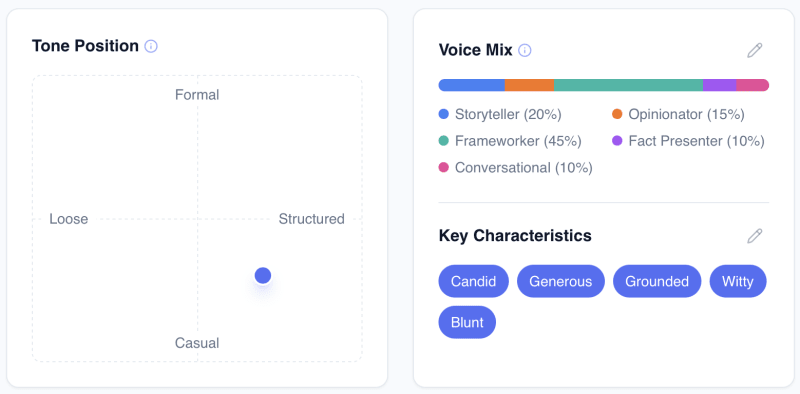
But a robust brand profile alone doesn't result in good writing output. Something has to understand and apply it.
3. The Engine That Reads It
The profile is the object. The engine is what interprets and applies, and this is where voice either holds past the first paragraph or collapses back into a stranger.
Every Flyletter agent has instructions on exactly how to understand your brand profile and how to apply it for its specific task. While this is task-specific, all Flyletter agents follow a few core principles:
The Character Principle
The profile fields are evidence of how you sound, not a checklist to deploy line by line.
This distinction is make or break. If the engine treats every field in the profile as a box to tick in every sentence, you get a draft that over-signals every trait at once and reads like an impression of you, not actually you.
A checklist produces a caricature. Evidence produces a person.
Reading fields as evidence means the engine decides which patterns matter for this specific piece and leaves the rest quiet. Your fragment habit shows up where a fragment lands, not on a set schedule. The character comes first, the fields are just proof of who that character is.
Per-Agent Slicing
The same profile gets sliced differently depending on the job.
Full voice for long-form drafting, where paragraph rhythm and argument architecture actually have room to breathe. A single-line slice for subject lines. A short-form slice for social copy.
A six-word subject line doesn't need your paragraph rhythm, it needs punch. Force the full-voice instruction set onto six words and you break the line trying to cram a personality into a headline. One profile, cut to fit the surface it's writing for.
Voice-neutral Instruction Language
The instructions themselves can't secretly bias the output toward one archetype. Write your directions in punchy, clipped, imperative language and you quietly push every voice toward punchy, even the writers who ramble beautifully and should.
This third layer decides what your voice actually sounds like, and how to apply it.
But what happens when these layers disagree?
The Floor Is a Floor, Not a Cage
They will disagree. The floor wants to strip a construction the profile insists is yours. When that happens, something has to win, and the layers run in a reverse order:
- Safety: Non-negotiable, always first.
- The writer's voice: Your patterns outrank the machine's defaults.
- The agent's task rules: The job-specific instructions for this surface.
- The universal floor: The generic-tell cleanup.
Notice voice sits above both task rules and the floor. That's on purpose. If the floor outranked your voice, it would flatten the exact quirks that make you sound like you, and you'd be back to a stranger, just a cleaner one.
Bottom Line
All of this is testable. Generate one draft with Flyletter. Read past the first few paragraphs. If the voice holds, you know the architecture is working.