The four-stage framework for newsletters that grow (the AI-era playbook)
The newsletters that scale past six figures all run the same four-stage system. The ones that stall miss at least one. Here's the framework.

8 min read
Every newsletter I've watched grow past six figures has done the same four things.
Every one that stalled out has missed at least one of them.
I know that sounds like an oversimplification. It's not. I've spent the last few years building and advising newsletters across SaaS, finance, and creator businesses. I've seen the ones that compound and the ones that flatline. And after a while, you stop calling it a pattern and start calling it the rules.
The difference between newsletters that scale and newsletters that plateau isn't content quality. It's not even consistency (though that matters). It's architecture. How the newsletter fits into everything else you do. How you treat it.
Most creators treat their newsletter like another channel. One of many. That's why their newsletter never compounds.
The ones who grow treat their newsletter as the only channel they actually own.
This distinction changes everything. And once you see it, the four stages become obvious.
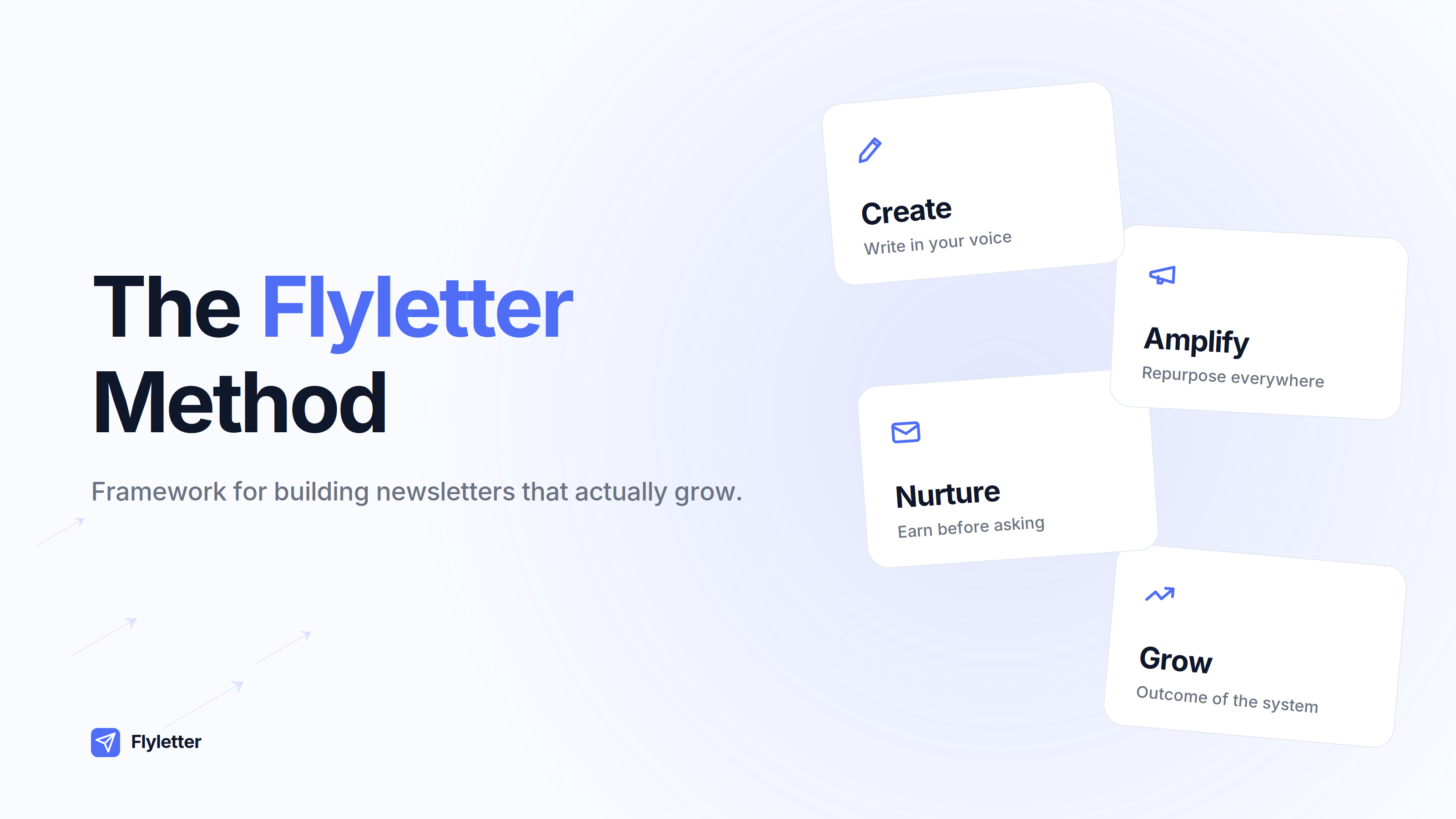
I call it the Flyletter Method.
For an applied breakdown, see:
- How creators run this framework to actually grow
- How 7-figure businesses run this framework
- How to run all four stages with AI
The Geometry of Newsletter Growth
Before I break down the four stages, I need you to see the shape of this thing.
Picture your newsletter at the center. Not as one spoke in the wheel, but as the hub. Social media, podcasts, SEO, partnerships, collaborations, all of those are spokes. They exist to feed the hub.
Why? Two reasons: because your newsletter is the only audience you actually own, and because your newsletter content is rich enough that you can repurpose it across channels.
So. Newsletter at the center. Everything else flows from there.
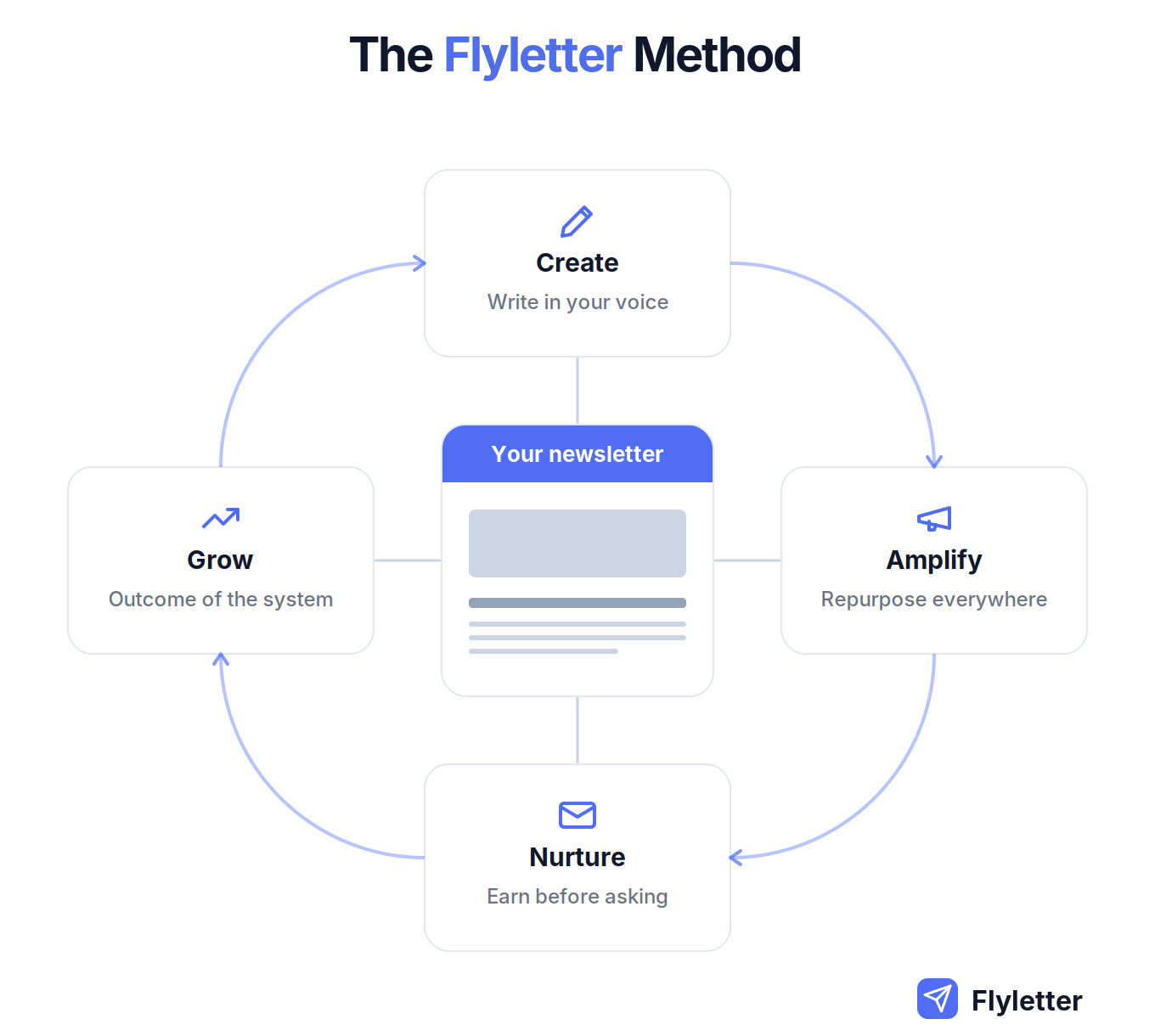
The Flyletter Method
The Flyletter Method consists of four stages:
- Create: Write consistently in your brand voice
- Amplify: Reshare your newsletter content everywhere
- Nurture: Build trust with your audience
- Grow: Reap the rewards of your efforts
Let's take a look at them each in detail and see how they all work together.
Stage 1: Create
This is where most people think they're doing fine.
They're not.
Creating isn't just publishing. It's publishing in your voice, on a consistent schedule, with content that delivers real value to a specific reader. Most newsletters die right here. The creator writes for everyone. Which means they write for no one.
Here's the failure mode I see constantly: someone launches a newsletter, publishes three great editions, then starts watching what other creators are doing. They drift. They borrow someone else's tone. They switch topics. By month three, the newsletter reads like it was written by a committee.
The fix is boring. It's unsexy. It works.
- Pick your reader. One specific person. Write to them every time.
- Pick your voice. Not a performance. Your actual perspective, your actual way of talking. The thing that makes your newsletter sound like you and not like a content template.
- Pick your cadence. Weekly, biweekly, whatever. Then protect it like it's sacred. Because it is.
That's the whole thing. Consistent, on-brand publishing in your real voice.
Skip it and nothing downstream works. Half-commit to it and nothing downstream works.
And yes, I know "just be yourself and show up" is the most recycled advice on the internet. There's a reason it keeps showing up. Most people don't do it. They publish when they feel like it. They drift off-voice the second they see someone else's format performing. Then they wonder why growth stalls.
Create is Stage 1 because without it, there's nothing to amplify, nurture, or grow. No foundation, no building.
Stage 2: Amplify
Okay, so you're creating consistently. Now what?
This is where the hub-and-spoke model earns its keep. You've written a newsletter. That newsletter contains ideas, frameworks, stories, insights. A near infinite number of content ideas and opportunities. And yet most people let all of that value live in one place only: the inbox.
That's leaving value on the table.
Write once. Repurpose everywhere. And then use that content to promote your newsletter.
One newsletter edition should produce:
- 3 to 5 social posts (pull key insights, reframe them for each platform)
- 1 to 2 short-form videos (if that's your thing, take the spiciest take and talk to camera for 60 seconds)
- 1 thread or carousel (the framework or list from your newsletter, reformatted for visual consumption)
- 1 community post or comment (share a condensed version in relevant communities where your readers hang out)
Every single one of these points back to the newsletter. That's the critical part. You're not creating content for X. You're creating content from your newsletter for X, with a clear path back to the hub, where you can capture people's emails for long-term nurturing.
The failure modes here: creating original content for every platform separately, or underestimating how much content your newsletter can actually produce. That burns you out and fragments your message. Your newsletter becomes an afterthought instead of the source.
Amplify turns one piece of writing into a full week of content. And all roads lead back to the list.
Stage 3: Nurture
Building a list means nothing if the people on it don't care enough to open your emails.
Nurture is the stage most people skip entirely. They focus on acquisition (get more subscribers), only ping that list when they have something to sell, and they forget about retention (keep the ones you have engaged and trusting you).
Think about it like this: every subscriber who stops opening your emails is a leak in the bucket. You can pour more water in, but if the bucket has holes, you'll never fill it.
Nurturing your list means:
- Deliver value before you ask for anything. As Gary V says, jab, jab, jab, right hook. Give value, give value, give value, then ask. If every email is a pitch, your list will die slowly and quietly.
- Respond to replies. When someone replies to your newsletter, that's a gift. Treat it like one. These are your most engaged readers. A personal reply turns a subscriber into a fan.
- Segment and serve. Not every reader needs the same thing. Pay attention to what resonates. Double down on the content that generates replies, clicks, and forwards.
- Clean your list regularly. This one's counterintuitive. Remove subscribers who haven't opened in 90 days. A smaller, engaged list outperforms a bloated, dead one every single time.
The failure mode: treating your newsletter like a broadcast channel instead of a relationship. Sending at people instead of writing to them.
Nurture is what converts rented attention (someone clicked a link on social media) into owned attention (someone who opens your email every week because they trust you). Without it, your growth is a revolving door.
Stage 4: Grow
This is the stage everyone wants to jump to first. "How do I get more subscribers?" "What growth tactics work?" "Should I run ads?"
And I get it. Growth feels like the thing that matters.
But growth is not a tactic. Growth is what the system produces when the first three stages run consistently.
If you're creating valuable content in a distinct voice, amplifying it across channels that all point back to your newsletter, and nurturing your existing subscribers into engaged readers who trust you, growth happens. Not overnight. But it compounds.
The specific growth activities that matter:
- Cross-promotions with newsletters that share your audience but aren't direct competitors
- Referral programs that reward your most engaged readers for spreading the word
- Lead magnets that give new subscribers an immediate reason to join (and a taste of your voice)
- Guest appearances on podcasts, in other newsletters, and on platforms where your target reader already hangs out
- Paid acquisition (once your nurture system proves you can retain subscribers profitably)
Notice that every one of these is more effective when the first three stages are working. Cross-promotions convert better when your content is consistently strong. Referral programs work when your readers are engaged enough to recommend you. Lead magnets work when your voice is distinct enough to stand out.
Growth is the output. The system is the input.
The failure mode: chasing growth tactics without the foundation. Running paid ads to a newsletter that publishes inconsistently. Doing cross-promotions when your open rates are tanking because you haven't nurtured your list. Trying to grow a bucket full of holes.
Bottom Line: The System Is the Strategy
So, four stages. Create, Amplify, Nurture, Grow. Each one depends on the ones before it.
Honestly, none of this is complicated. That's what makes it frustrating, because if it were complicated, you'd have an excuse. But it's not. It's consistent execution across four stages, with your newsletter at the center of everything.
The newsletters that scale past six figures all do these four things. The ones that stall under five thousand subscribers have missed at least one.
Which stage are you missing?
Figure that out, fix it, and the compounding starts. No hack. Just the geometry of how this actually works.